
Maslow's hierarchy of needs
What if your own fulfillment was not only dependent on you but on the basic needs present for each human being? What if understanding your needs would allow you to approach more easily a feeling of well-being?
Key takeaways
- Maslow's hierarchy of needs, created by Abraham Maslow in the 1950s, organizes human needs into 5 levels.
- Lower-level needs must be satisfied before higher-level needs can be pursued.
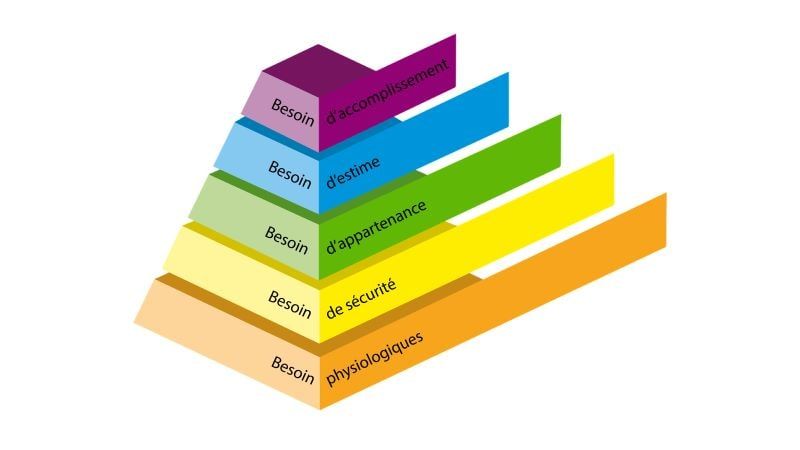
- The 5 levels: physiological, security, social belonging, esteem, and self-realization needs.
- The theory is criticized for underestimating social relationships and for being too linear.
- Understanding these needs helps identify levers of motivation and commitment.
WHAT IS MASLOW'S HIERARCHY OF NEEDS ?
Maslow's hierarchy of needs was created by Abraham Maslow in the 1950s. Later, this theory will be represented (wrongly) by a pyramid. This pyramid makes it possible to categorize the needs of individuals in the form of 5 different levels. This pyramid took shape by working on a theory of hierarchy of needs and motivations of individuals.
Needs are therefore central for Maslow. Its pyramid allows for hierarchizing the needs of individuals. Indeed, even if each individual is unique, our needs are common to all. In order to realize the different needs, those of the lower levels must first be satisfied. The satisfaction of these basic needs will allow the individual to access the well-being.
MASLOW'S PYRAMID IN DETAIL
Here are the 5 needs named by Maslow
Physiological needs :
These needs constitute the foundation, the base of the pyramid. In these physiological needs therefore to maintain survival and the internal balance of the individual.
How to satisfy its physiological needs?
We can for example find the fact of eating, sleeping, drinking … If these needs are not satisfied, the individual's main motivation will be to fulfill them, leaving no room for other needs.
Security needs :
Once physiological needs are met, the individual can begin to achieve some of his or her secure needs. These are part of a more social sphere, and will lead to specific behaviors that may vary from one culture to another. They are going to be dependent on the stability of the family circle, the income level or the mental health of the individual. There are two types of security, physical security and mental safety.
How to satisfy this need for security?
In these needs we can find the fact of having a security of housing, employment or physical security. These needs can be met individually or collectively
Need for social belonging :
These needs represent the third level of the pyramid. This level appeals to the social dimension of the individual. The need to belong is essential for the proper development of the individual. If this one is not satisfied, the person can create an attachment or an overdependence that will lead to a loss of autonomy.
How to satisfy this need for social belonging?
The person will need to feel accepted in a group, to feel loved, to have a social status. Thus we all need love, affection, socialization, communication…
Esteem and self-esteem needs :
Once we are integrated into a company or group, we need to be recognized as our own entity, to be appreciated and valued. So we need to be considered by other people, to have respect and value.
In this category also enters the self-esteem that is to say the self-evaluation of ourselves. An individual who is valued by others may not have high self-esteem and vice versa.
How to satisfy this need for self-esteem?
Different means can satisfy these needs. There will be material needs (housing, car…) and immaterial needs (social status, degree… ). The means to satisfy self-esteem vary according to cultures, times and people. Self-esteem can be fulfilled by what you have or what you are.
Needs for self-realization, accomplishment :
This level is the 5th and final level of Maslow's needs pyramid. According to Maslow's theory, this can only be achieved if the 4 previous ones have been satisfied. The realization of self is an active, not a passive process. The goal is to act!
How to satisfy this need for self-realization?
Thus the individual needs to develop himself, to increase his knowledge, to develop certain values, or to reach a personal goal. The person will seek to fulfill themselves as a person.
CRITICISMS OF MASLOW'S PYRAMID
This Pyramid of Needs is subject to much criticism from various professionals.
- Maslow does not sufficiently emphasize the importance of social relationships : Indeed, the culture can modify the basic needs of this pyramid. If the individual is in a collectivist society, for example, the group is going to be of much greater importance than in an individualist society. In the same way, according to the periods, the geographical places … The different needs will not have the same importance.
- A thinking of needs that is too linear and schematic : The human being and his psychological processes are complex and cannot fit into well defined cases. Some of our needs can manifest themselves in a joint way and not one after the other, having the same importance for the individual.
Still, it is important to qualify this hierarchy of needs. Maslow explains in particular that the emergence of needs does not occur suddenly and unexpectedly but appears little by little in a gradual way. That is to say that as one need begins to be satisfied the next begins to surface little by little.
WHAT DOES MASLOW'S THEORY OF HIERARCHY OF NEEDS PROVIDE ?
This Maslow pyramid is part of his theory of motivation. Indeed, this pyramid allows us to understand what lies behind our motivations. Thus, a better understanding of the different needs of individuals would make it easier to find the levers of motivation and commitment on a daily basis. The more the needs are met, the more the person will be committed to the task.
Conversely, if the previous needs are not sufficiently fulfilled, the person will present less commitment to the task, which can lead to more difficulties with change.
The AI revolution !
Try our artificial intelligence for free and discover how it can support you in your daily life.

Frequently asked questions about Maslow’s hierarchy of needs and virtual reality
What is Maslow’s hierarchy of needs?
Maslow’s hierarchy of needs classifies human needs into five levels: physiological needs, safety, social belonging, esteem and self-actualization. Developed by Abraham Maslow in the 1950s, it is based on a theory that organizes human needs and motivations into a hierarchy.
Do all needs have to be satisfied in order?
Maslow explains that needs emerge progressively rather than suddenly. As soon as one need begins to be satisfied, the next gradually appears, without requiring the previous need to be fully met.
What are the main criticisms of Maslow’s hierarchy of needs?
Two main criticisms are commonly raised: the model may not give enough importance to social relationships, which vary across cultures, and its overly linear structure may not reflect the complexity of human psychological processes, as several needs can arise at the same time.
How does Maslow’s theory help us understand motivation?
Maslow’s hierarchy is part of a broader theory of motivation. Better understanding an individual’s needs helps identify the factors that drive motivation and engagement in everyday life: the more these needs are met, the more likely the person is to engage in a task.
Why use virtual reality in mental health?
Virtual reality enables gradual and controlled exposure to anxiety-provoking situations in a safe and reproducible environment. It can improve patient engagement and be personalized according to individual needs.
Can I feel nauseous when using a virtual reality headset?
Yes, this can happen. This phenomenon, known as cybersickness, is reversible and well documented by researchers. It is recommended to begin with static environments and then gradually introduce slight head movements.
Which patients can benefit from virtual reality exposure therapy?
Research shows that virtual reality exposure therapy can be effective across a wide range of populations, including adults, adolescents and older adults. However, people with epilepsy and pregnant women are not eligible for this type of therapy.
Author
C2Care
Related articles

The Theory of Constructed Emotion
Many models attempt to explain the functioning and development of emotions. This recent model offers a new perspective on emotional skills and the cultural variations of them.

Workaholism: the addiction to work
Workaholism or "boulomanie" in French refers to addiction to work. Unlike many other addictions, its symptoms such as presenteeism (being at work even when you shouldn't be) or over-investment in work are often valued in companies, which makes it more insidious and difficult to treat than most addictive disorders. However, as with all addictive behaviors, it exposes those affected to very significant health risks (hyperstress, burnout, depression).

Self-affirmation: communication technique
Today, we are going to discuss an essential element of cognitive-behavioral therapy applied and enhanced by virtual reality: assertiveness. Which of your patients will be concerned by this type of technique? It is mainly patients who suffer from social phobias. So often, those who have difficulty speaking in public, those who are afraid to express themselves, those who are afraid to say "no" or those who do not dare to assert their point of view.

Self-determination
What if completing a task did not depend solely on you? What if your personality was governed by fundamental psychological needs and that meeting these needs could lead you to personal fulfillment? To be self-determined is to be able to respond to a sense of freedom, interest, appreciation and acceptance at the same time. Being self-determined is therefore fundamental to our well-being.

Self-stigma
Belonging to a minority group can cause a lot of suffering. Most often this suffering comes from outside, from majority groups or from other minority groups. But the stress and suffering related to this status can also come from within. Low self-esteem, dysfunctional beliefs, repetition of toxic patterns, self-stigmatisation adds further suffering to the minority experience. It is interesting to understand how this mechanism works in order to better support people who suffer from it.

ACT therapy
In mental health and in the context of psychotherapy, one element often comes up as a source of suffering: the need for control, and the distress it brings when, inevitably, certain elements escape this control, which can lead to a feeling of incapacity. ACT is one of the tools to overcome this difficulty.